
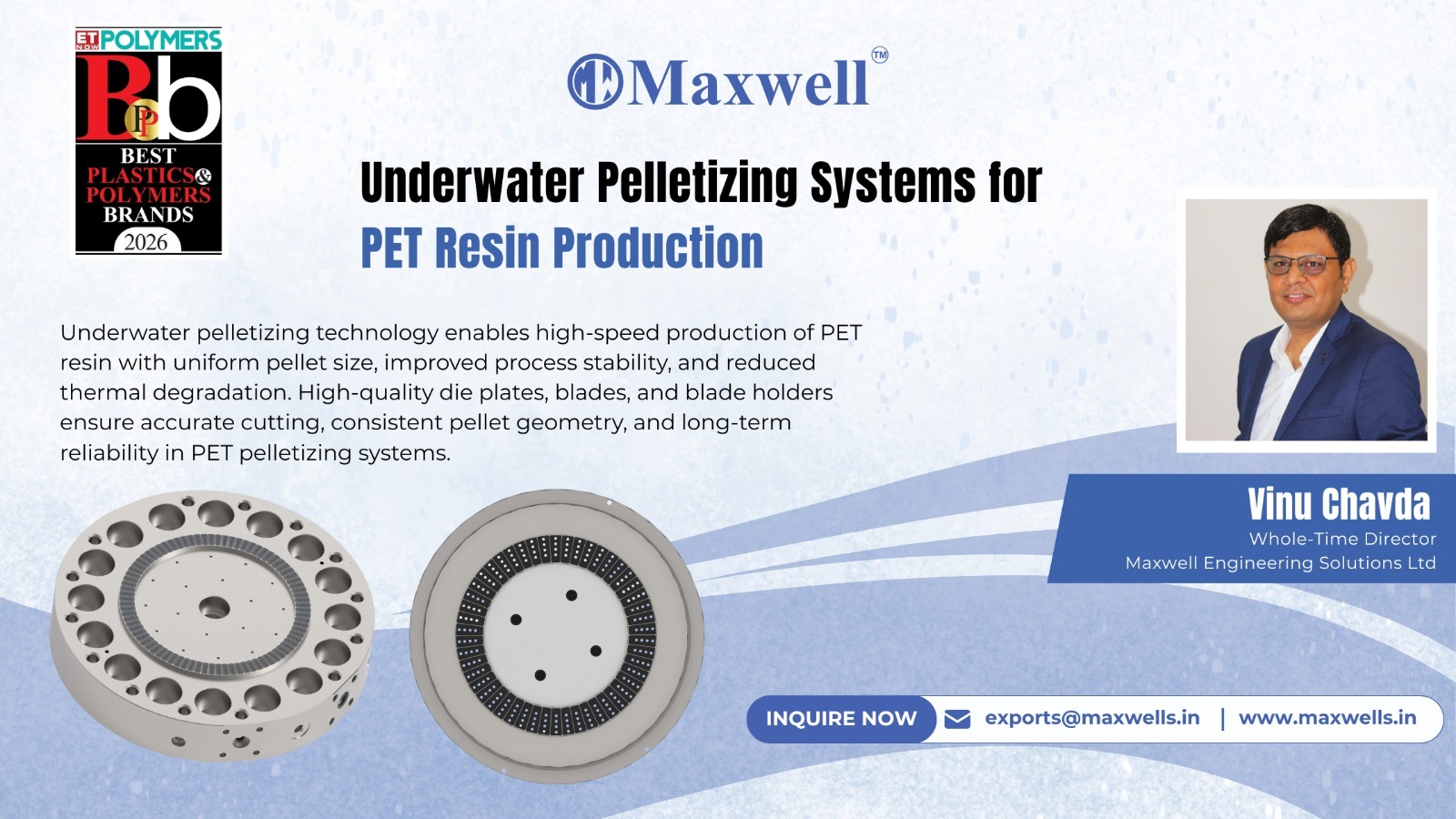
Underwater Pelletizing Systems for PET Resin are widely used in modern polymer production to ensure consistent pellet quality and high processing efficiency.
Polyethylene Terephthalate, or PET, is one of the most popular and commercially significant polymers in use today. From beverage containers and food packaging materials to fibers and films, the world’s demand for high-quality PET resin continues to increase. At the heart of any state-of-the-art PET resin production facility is the pelletizing process. For high-speed, high-quality operations, underwater pelletizing has become the industry standard.
Knowing why underwater pelletizing is so suitable for PET resin production and what it requires from high-performance components is information that can be very useful in any operation in the industry.
Why PET Resin Requires Quality Pelletizing
PET is widely used in packaging, fibers, and films due to its excellent mechanical and chemical properties. According to industry insights from PlasticsEurope, PET continues to be one of the most important polymers in global packaging and manufacturing industries.
PET resin is a thermally sensitive and hygroscopic material. During melt processing, it is susceptible to thermal and hydrolytic degradation, which can impact intrinsic viscosity, an important quality specification for PET resin. All facets of the process, from drying and extrusion through pelletizing and packaging, require careful control to maintain IV.
Conventional strand pelletizing, while popular, has inherent disadvantages that can limit its effectiveness in high-speed PET resin production. Breakage, ambient moisture absorption during cooling, and inconsistent quench rates can all impact quality, and these problems become more critical at high production rates. Underwater pelletizing eliminates these problems in a very efficient mann
How Underwater Pelletizing Works for PET
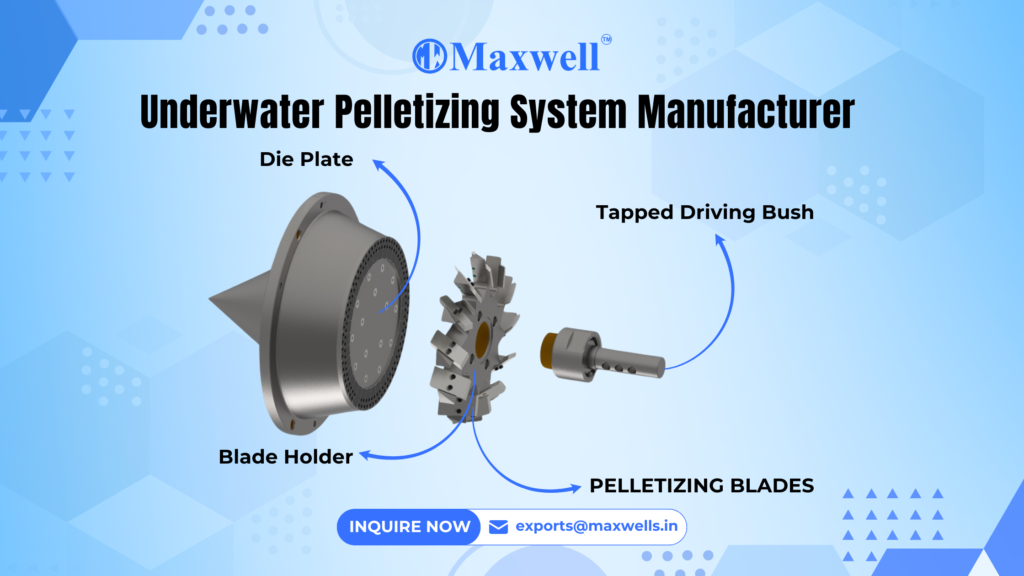
In an underwater pelletizing process, molten polymer exits the die plate through accurately drilled holes directly into a temperature-controlled water stream. Blades rotate and cut the molten polymer at the die face, and pellets are quenched and conveyed in water into a centrifugal dryer.
The above process has several significant benefits in the production of PET resin pellets:
Consistent pellet geometry: Cutting at the die face/perforated plate in an accurately controlled environment in contact with water provides highly consistent and spherical pellets with critical tolerances required in further processing, like bottle preform preparations.
Rapid and uniform quenching: Immediate contact with water prevents oxidation and limits the time window for thermal degradation, thus preserving IV.
Reduced ambient moisture exposure: Since pellets are processed and transported in an accurately controlled environment in contact with water before drying, there is no chance of ambient moisture absorption during the quenching process.
High throughput capability: UWP technology can easily increase production rates while avoiding strand handling problems that limit conventional pelletizers at high production rates.
Process stability: There is no strand breakage, and the continuous nature of UWP operation provides stable and predictable production processes with fewer operator interventions.
The Critical Role of Die Plates in UWP for PET
The die plate/perforated plate is arguably the most technically demanding item in an underwater pelletizing system for PET resin. Its performance has a direct impact on the quality of the produced pellets, the efficiency of the process, and the required maintenance interventions.
The die plate/perforated plate for PET resin processes must satisfy several stringent criteria:
Thermal uniformity: The die plate face must be isothermal in all holes. Any cold spots cause freeze-off, and hot spots cause degradation. The proper design and configuration of heating channels are crucial. Hole geometry and surface finish: The geometry of the bore in each die hole affects the shape and quality of the cut and the propensity for stringing and angel hair. A mirror-finish surface reduces friction and prevents excessive heating.
Material specification: PET resins, particularly recycled PET and some blends, may contain abrasive fillers and/or contaminants. Tool steels must be carefully selected, and surface treatments must be compatible with the application.
Face flatness and hardness: The die plate face must be ground to a high flatness tolerance to ensure proper contact between the rotating blade assembly and the plate.
The type of blades and blade holders must also be matched to the specification of the die plate. Blade type and material grade, as well as the spring loading of the blades within the holder assembly, will also be important factors in the quality of the cut and the rate of blade and die face wear.
Refurbishment and Re-engineering for UWP Components
For the production of high-throughput PET materials, die plate wear is an accepted condition rather than an unexpected one. Those who design and implement an effective refurbishment strategy to restore die face flatness, hole surface finish, and worn heating elements will be rewarded with extended component lifespan and therefore lower total cost of ownership compared to the routine replacement of worn parts.
Maxwell Engineering Solutions Limited offers die plate refurbishing and reconditioning as part of its comprehensive die plate manufacturing offering. This means that worn die face components can be restored to near-new conditions. Those running continuous PET production lines will benefit from the company’s spare parts management and contracting service, which provides a structured supply chain to prevent unplanned outages due to parts availability.
Conclusion:
Underwater pelletizing systems are the first choice in the production of high-quality PET resins in high volumes with superior pelletizing characteristics, IV retention, and process reliability compared to conventional processes. Ensuring consistent achievement of these advantages over the entire life of a production line relies in large part on the accuracy and reliability of the die plates, blades, and blade holders at the heart of an underwater pelletizing system.
The full range of precision die plates, pelletizing blades, and spares available from Maxwell Engineering Solutions Limited can be found at maxwells.in.