
Underwater Pelletizing Solution for PET Recycling is becoming the standard for modern PET recycling plants that need consistent pellet quality, higher output, and stable melt control. PET recycling has improved a lot over the last few years, but that doesn’t mean the process has gotten easier.
That’s where many traditional processing setups start to fall short. Recycled feedstock isn’t always consistent, and small variations from batch to batch can quickly affect pellet quality. On the plant floor, reliability and repeatability matter just as much as throughput. For this reason, underwater pelletizing is often chosen for large PET recycling lines, not as a novelty, but as a practical solution.
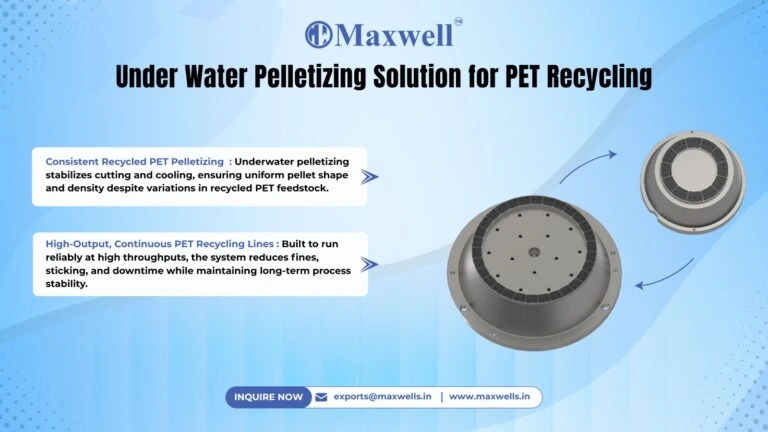
By cutting and cooling the polymer directly under water, the process avoids several common issues seen with air cooling or strand systems. Pellet shape stays more uniform, density is easier to control, and overall handling becomes more predictable. With PET, these details tend to show up very clearly in day-to-day operation.
The following sections focus on how underwater pelletizing is applied in PET recycling today, why it fits recycled material particularly well, and which system design factors actually make a difference in industrial environments.
What Is Underwater Pelletizing for PET Recycling?
In simple terms, underwater pelletizing is the stage where molten PET is turned into pellets while still inside a water-filled cutting chamber. The polymer exits the die plate and is cut immediately, before it has a chance to cool in open air. The water absorbs heat right away, so the pellets solidify almost instantly.
This approach is particularly useful for PET. PET needs higher processing temperatures, and even small temperature swings can affect how the material behaves. Once recycled content is added to the mix, those variations become more noticeable. Differences in viscosity or melt stability can quickly show up in pellet shape if the process isn’t well controlled.
By cutting and cooling the material underwater, the process stays more stable. Pellet shape is easier to control, sticking is reduced, and density/pellets per gram(ppg) stays more uniform across production runs. That consistency is one of the main reasons underwater pelletizing is commonly used on PET recycling lines that run at higher throughputs or operate continuously.
Why PET Recycling Requires Advanced Pelletizing Technology
Anyone who works with recycled PET knows it behaves differently from virgin material, even when everything looks fine on paper. Conditions inside the plant don’t always stay steady, and when something shifts, the pelletizing stage is usually where the problem shows up first.
Temperature is one obvious factor, but it’s rarely the only one. PET has to be run hot, and recycled material doesn’t always react the same way every time. A small change in flake quality, moisture, or melt behavior can be enough to cause pellets to stick, lose shape during cooling, or come out unevenly. These issues aren’t always dramatic, but they add up quickly.
At higher production rates, those inconsistencies become harder to ignore. Systems that perform reasonably well at lower outputs can start drifting once throughput increases or feedstock quality changes. That’s why underwater pelletizing is often used in PET recycling, not because it’s more complex, but because it handles variation better and keeps pellet quality within a tighter range over longer runs.
How Underwater Pelletizing Systems Work
Once the PET flakes have been washed and dried, everything depends on how stable the melt stays in the extruder. The material is heated and pushed forward, but in real operation, pressure and temperature aren’t just set values; they’re things operators watch constantly. Any drift here shows up later in the pelletizing stage.
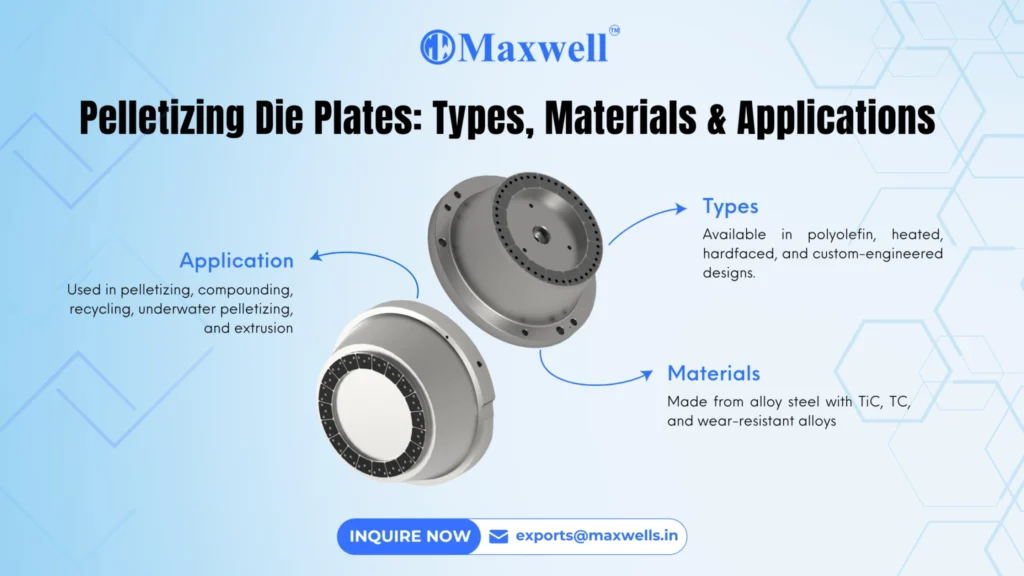
As the molten PET moves toward the pelletizer, the die plate becomes the focal point. It does more than shape the melt. Flow balance, wear patterns, and even how hard the system can be pushed are all tied to die plate design. With recycled PET, small contaminants or material inconsistencies tend to accelerate wear, so machining quality and material selection make a noticeable difference over time.
At the die face, rotating blades cut the melt directly under water. This part of the process leaves very little room for error. If blade alignment is slightly off or cutting conditions aren’t right, fines increase and pellet shape starts to drift. Plants usually see the effect quickly, which is why blade condition and setup get so much attention during maintenance.
Right after cutting, the pellets are cooled by the water and solidify almost immediately. From there, they’re separated, dried, and conveyed downstream. When the system is properly tuned, this whole sequence runs continuously, without stop-start handling, and produces pellets that stay consistent over long production runs.
Key Components of Industrial Underwater Pelletizing Systems
In an industrial underwater pelletizing setup, long-term performance depends heavily on a few core components. When recycled PET is involved, these parts aren’t just supporting elements, they directly influence stability, wear, and pellet quality over time.
Die Plates for PET Applications
Die plates in PET recycling systems are built to handle constant thermal and mechanical stress. They’re usually made from high-grade alloys and machined to tight tolerances, not for appearance, but for durability. Wear resistance and thermal stability matter here, especially when feedstock quality changes from batch to batch.
In real operation, recycled PET doesn’t always flow the same way. Minor variations in material can affect pressure, flow balance and material wastage in back-flush system, and that’s where a well-designed die plate makes a difference. Plants often notice that better die quality translates into longer run times and fewer interruptions for inconsistent pellet shape/tails and die plates holes freezing.
Pelletizing Blades
Pelletizing blades work under some of the toughest conditions in the system. They’re cutting molten polymer continuously, while being exposed to heat, water, and mechanical load at the same time. Because of that, blade material, hardness, and alignment all matter more than they might seem at first.
Even small improvements in blade quality or setup can show up quickly in pellet shape and fines generation. For many operators, blade condition is one of the first things checked when pellet quality starts to drift.
Pelletizing Chamber and Water System
The pelletizing chamber brings everything together. It holds the die plate and blades while also controlling water flow and temperature around the cutting area. If water management isn’t stable, pellet quality usually isn’t either.
A well-designed chamber helps remove heat efficiently, resists corrosion, and allows the system to run smoothly without constant adjustment. Over long production runs, stable water conditions play a major role in keeping pellet size and shape consistent.
Underwater Pelletizing Compared to Other Methods
In practice, most PET recycling plants don’t choose a pelletizing method based on theory alone. The decision usually comes down to what keeps running smoothly once the line is under load. Compared with strand pelletizing, underwater pelletizing tends to handle higher outputs with fewer interruptions, especially when automation is part of the setup.
Pellet quality is another factor that becomes more noticeable over time. At higher throughputs, small variations in cooling or cutting can quickly show up downstream. For PET recycling, underwater pelletizing is often selected not because it is the simplest option, but because it remains stable when operating conditions are less predictable.
The Role of Equipment Manufacturers in PET Pelletizing
Out on the plant floor, how a pelletizing system is actually built often matters just as much as the process being used. Two systems can look identical on paper, yet after months of operation, the differences become clear. Details like machining accuracy, material selection, and assembly quality tend to show their impact gradually rather than all at once.
That’s why suppliers with real-world PET recycling experience usually focus less on headline output numbers and more on durability and maintenance. Recycled material isn’t consistent, and wear is simply part of daily operation. Equipment that’s designed with those realities in mind generally stays productive for longer and requires fewer interruptions.
Manufacturers such as Maxwell approach die plates and blade assemblies from this practical angle. Instead of assuming perfect conditions, the equipment is built to cope with variation in recycled PET. In many plants, factors like flexible system layouts, access to spare parts, and reliable technical support end up having more influence on uptime than any single design feature.