
If you work with plastic compounding, polymer processing, or any application where pelletizing is part of your line, you have likely faced the question: underwater pelletizing or water ring pelletizing? Both systems have earned their place in industrial production. But when it comes to the demands placed on the pelletizing die plate, the component at the very heart of both systems, they are not the same.
This matters more than most people realise. Choosing the wrong die plate specification for your pelletizing system is one of the most common causes of early wear, inconsistent pellet quality, and unplanned downtime. At Maxwell, we work with plant engineers and production managers who deal with this exact question, and the answer is almost always the same: the system dictates the die, not the other way around.
In this article, we break down how underwater and water ring pelletizing systems differ, how those differences translate into die plate requirements, and which system genuinely demands a higher-specification die plate.
Understanding the Two Systems: A Quick Primer
Before we get into die plates, it helps to have a clear picture of what each system actually does.
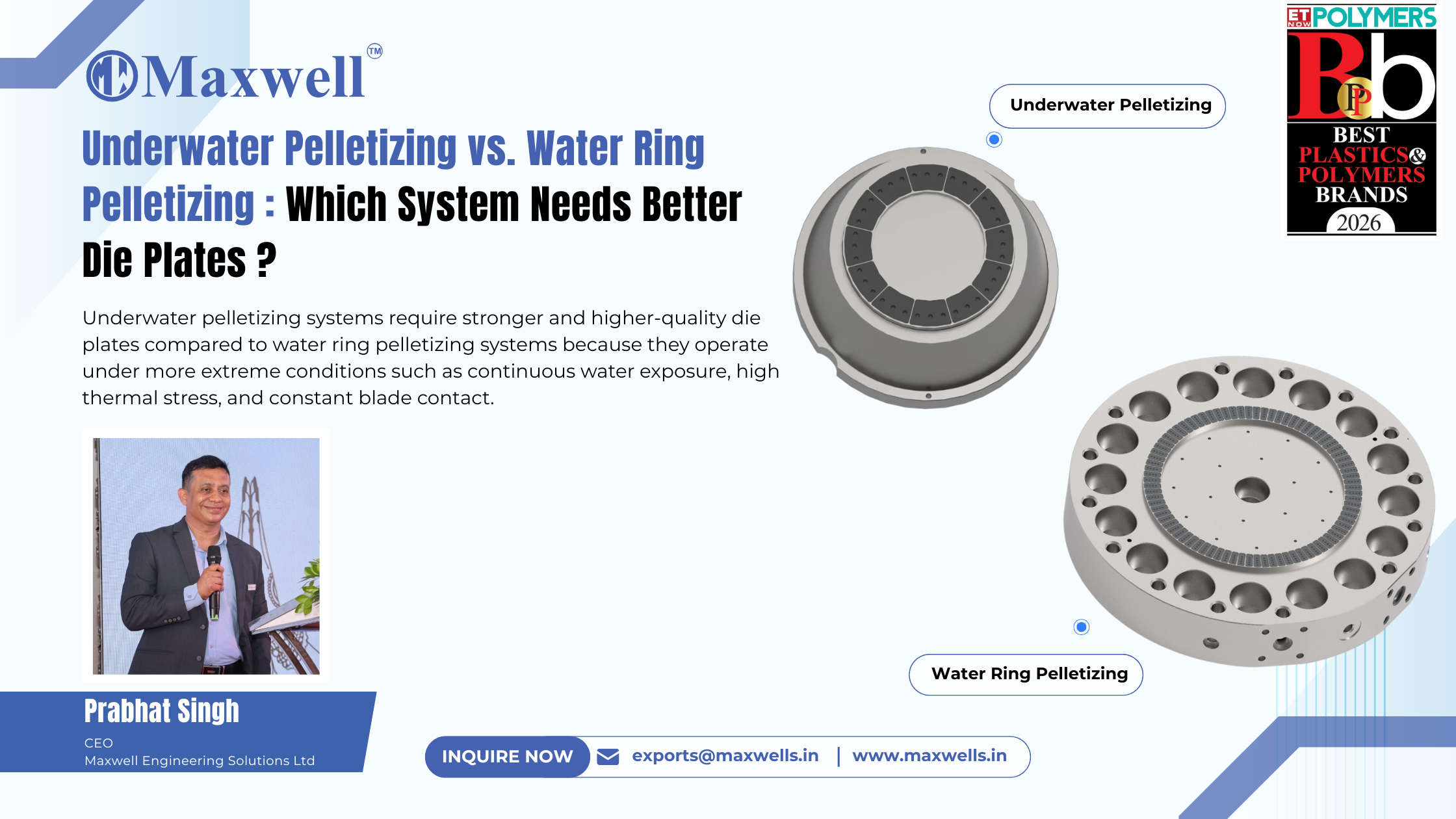
Underwater Pelletizing
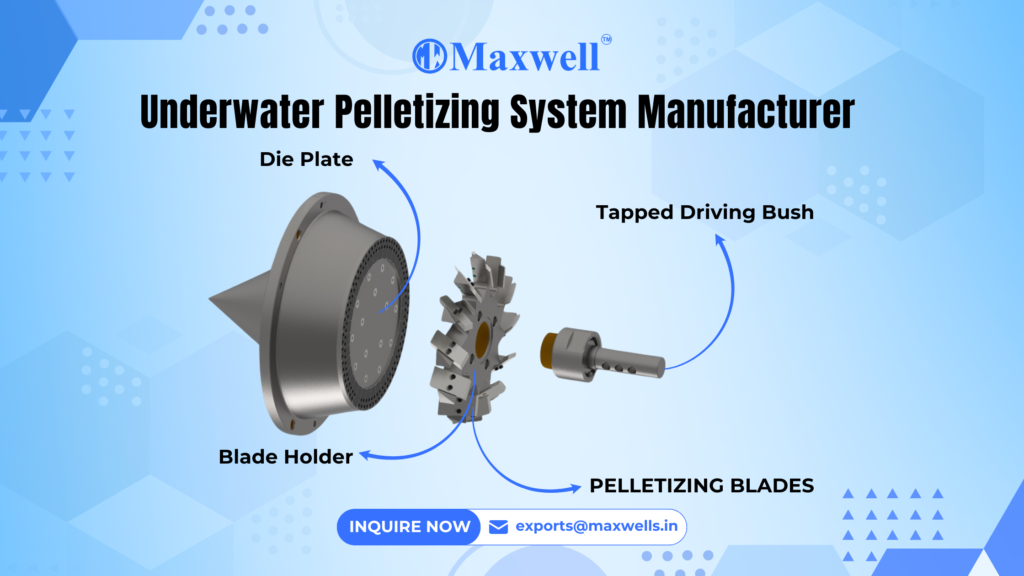
In an underwater pelletizing system, the molten polymer is extruded through a die plate directly into a water-filled cutting chamber. A high-speed rotating cutter blade slices the strands into pellets the moment they exit the die holes while still submerged in temperature-controlled water. The pellets are then carried by the water flow to a drying system where excess water is removed.
The die plate in this setup is continuously in contact with water on one face and with molten polymer under high pressure on the other. This creates a very specific and very demanding thermal and mechanical environment.
Water Ring Pelletizing
A water ring pelletizing system operates differently. The polymer strands exit the die plate into open air, where a rotating cutter immediately cuts them into pellets. A ring of water surrounds the cutting zone not submerged, but rather as a curtain or spray that cools and transports the pellets after they are cut.
The die plate in this system faces thermal stress from the hot melt side but is not continuously submerged. The cutting action and the thermal gradient are somewhat less extreme compared to the fully submerged underwater process.
How Each System Stresses the Die Plate Differently
The performance of your pelletizing die plate is directly tied to the conditions it operates under. Let us look at what each system actually puts the die through.
Thermal Gradient Stress
In underwater pelletizing, the die plate is exposed to molten polymer temperatures that can exceed 250°C to 300°C on the melt side, while the water-facing side is constantly cooled to temperatures as low as 20°C to 60°C. That is a temperature differential of 200°C or more across a single component, often just 20 to 50 mm thick.
This repeated thermal cycling causes fatigue over time. The die plate must maintain dimensional stability, resist thermal expansion, and avoid micro-cracking along the hole walls. This is not something a standard or lower-grade die plate handles well for long.
Water ring pelletizing involves thermal stress too, but the absence of continuous water contact on the die face means the gradient is less severe. The die still gets hot, but it cools more gradually.
Corrosion and Chemical Exposure
Underwater die plates are in constant contact with water and depending on the material being processed, that water can carry chemical additives, colorants, or abrasive fillers. Corrosion is a genuine threat to die plate longevity in this environment.
High-alloy stainless steel grades typically 4Cr13 or X46Cr13 with additional surface treatments are recommended specifically to resist this corrosion-wear combination. Water ring systems face less direct water exposure at the die surface, which gives more flexibility in steel grade selection.
Pressure and Throughput Demands
Underwater pelletizing systems typically operate at higher melt pressures because the die plate must push material through while the water on the other side creates back pressure. The hole geometry, specifically the L:D (length-to-diameter) ratio must be carefully engineered to manage this pressure without causing bridging or die drool.
Water ring systems also work under pressure, but the open-face design generally allows for slightly more forgiving operating conditions.
Cutting Blade Interaction
In both systems, a rotating cutter blade makes contact with the die face. In underwater pelletizing, this contact happens continuously in a water environment, which changes the lubrication dynamics between blade and die. The die face hardness and surface finish matter enormously here; a softer or rough-finished die face will show scoring and wear from the blade far sooner.
Pelletizing Die Plate Comparison: Underwater vs. Water Ring
Here is a direct comparison of the die plate requirements for both systems:
|
Die Plate Factor |
Underwater Pelletizing |
Water Ring Pelletizing |
|
Thermal gradient tolerance |
Extreme (200°C+ differential) |
Moderate |
|
Corrosion resistance required |
High constant water exposure |
Moderate spray/curtain only |
|
Recommended steel grade |
4Cr13, X46Cr13 or higher alloy |
4Cr13 or standard alloy steel |
|
Surface hardness (HRC) |
58–62 HRC minimum |
55–60 HRC |
|
Die face surface finish |
Mirror-polished (Ra ≤ 0.4 µm) |
Fine-ground (Ra ≤ 0.8 µm) |
|
Hole geometry precision |
Critical tight L:D tolerance |
Important moderate tolerance |
|
Heating element integration |
Often required (heated die plate) |
Less common |
|
Cutter blade contact severity |
High submerged continuous contact |
Moderate open air contact |
|
Overall die plate specification |
Higher grade required |
Standard to mid-grade sufficient |
So Which System Needs Better Die Plates?
The short answer: underwater pelletizing systems demand a higher-specification pelletizing die plate consistently and significantly.
That does not mean water ring pelletizing die plates can be low quality. Any die plate that is underspecified for its system will wear prematurely and create production problems. But the cumulative stresses of continuous water immersion, extreme thermal gradients, high melt pressure, and submerged blade contact in underwater pelletizing create a much more hostile environment for the die.
Here is what a premium-grade underwater pelletizing die plate needs to deliver:
- Exceptional thermal stability: must maintain hole geometry through repeated heating and cooling cycles
- High surface hardness with a polished die face: to withstand blade contact without scoring
- Corrosion-resistant alloy steel: suitable for continuous water and chemical exposure
- Precision-drilled holes with tight L:D ratios: to manage back pressure and prevent die drool
- Integrated heating channels (in many designs): to keep the die face at optimal melt temperature
Water ring pelletizing systems, by comparison, can often perform well with a well-made mid-grade die plate provided it is correctly specified for the material being processed, the compression ratio is right, and the die is maintained properly.
What Happens When You Use the Wrong Die Plate?
We see this situation regularly. A plant upgrades to an underwater pelletizing system or switches materials and the existing die plate, which worked adequately in a less demanding environment, starts showing problems within a fraction of its expected service life.
Common failure symptoms include:
- Die drool: molten polymer oozing around hole exits rather than cutting cleanly
- Irregular pellet shapes: caused by uneven hole wear or inconsistent surface hardness
- Scoring on the die face: from blade contact on a surface that is too soft or not polished
- Thermal cracking: micro-fractures radiating from hole walls due to poor alloy selection
- Corrosion pitting: particularly around holes exposed to water and additive chemicals
Each of these symptoms shortens die life, reduces pellet quality, and adds cost to your operation. The fix is not always to buy more frequently, it is to specify correctly the first time.
Maxwell Die Plates: Built for the Demands of Both Systems
At Maxwell, we manufacture pelletizing die plates for both underwater and water ring systems, and we treat the two as genuinely different products, not variations of the same component.
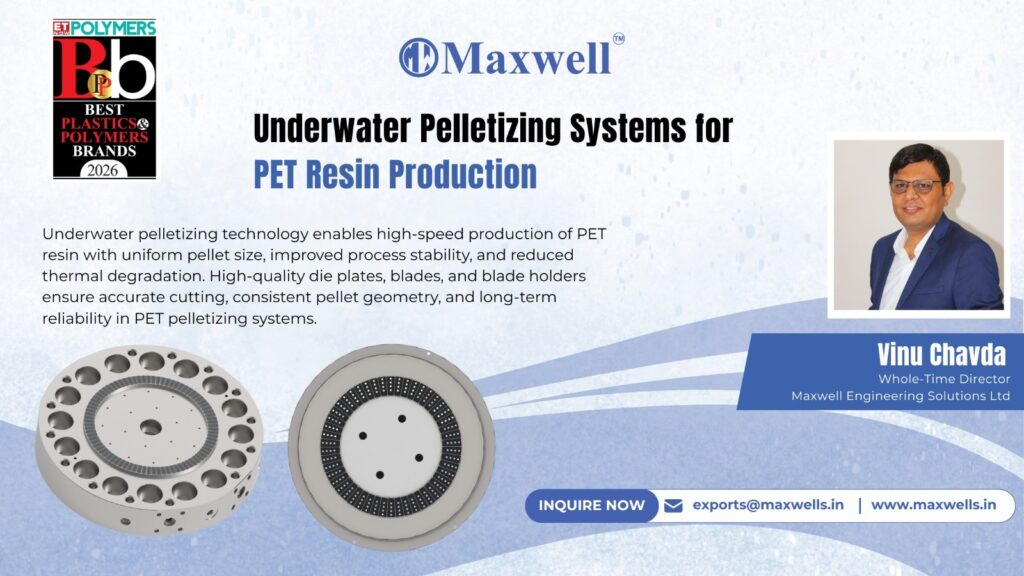
For underwater pelletizing applications, our die plates are produced from high-alloy steel with surface hardness specifications appropriate for the cutter blade contact and thermal cycling demands of full submersion operation. Hole drilling is done with high-precision CNC equipment to ensure consistent L:D ratios and smooth internal finishes that minimise friction and resist wear.
For water ring pelletizing systems, we offer correctly-graded die plates that deliver reliable service life without the over-engineering and the cost premium of an underwater specification. The result is a die plate matched to the actual demands of the system, not a compromise in either direction.
If you are uncertain which die plate specification your system requires, or if you are seeing premature wear and want to understand why, our technical team is available to help. Explore our pelletizing die plate range or contact Maxwell directly for a system-specific recommendation.
Key Factors to Evaluate When Specifying a Die Plate for Either System
Whether you are sourcing a die plate for an underwater or water ring system, these are the factors you should confirm with your supplier before placing an order:
- Steel grade and hardness specification ask for the exact alloy designation and hardness range (HRC), not just ‘stainless steel’
- Surface finish on the die face: request Ra (roughness average) value; for underwater systems, Ra ≤ 0.4 µm is a benchmark
- Hole L:D ratio: confirm this is optimised for your specific material and throughput rate
- Heat treatment process: proper hardening and tempering protocols significantly affect performance under thermal cycling
- Heating element compatibility: for underwater dies, confirm whether the design accommodates cartridge heaters or external heating
- Dimensional conformance to your pelletizing unit: bolt pattern, die OD, and hub dimensions must match your specific machine model
Do not accept vague answers on any of these points. A supplier who cannot provide specific data on steel grade, hardness, and hole geometry is unlikely to consistently deliver a die plate that meets the demands of either pelletizing system over the long term.
Final Thoughts
Both underwater pelletizing and water ring pelletizing are proven, effective systems and both deserve a die plate that is correctly matched to their operating demands. But if you are looking at which system places the higher burden on the die plate, the answer is clear: underwater pelletizing does.
The combination of thermal extremes, constant water exposure, high operating pressures, and continuous blade contact in an underwater system means the die plate specification cannot be treated casually. Getting it right pays back in longer service life, consistent pellet quality, and fewer production interruptions.
For a pelletizing die plate comparison specific to your application, or to discuss die plate maintenance tips that apply to your existing system, reach out to the Maxwell team. We are here to help you get more from every die.
Frequently Asked Questions
What is the main difference between underwater and water ring pelletizing die plates?
The primary differences are in steel grade, surface hardness, and surface finish. Underwater pelletizing die plates must withstand continuous water immersion, extreme thermal gradients, and constant blade contact in a submerged environment all of which require a higher-specification alloy, harder surface treatment, and a more precisely polished die face compared to water ring pelletizing die plates.
Can I use the same die plate for both underwater and water ring systems?
In most cases, no and attempting to do so usually leads to premature failure of the die plate. The dimensional requirements (bolt pattern, hub, OD) are often different between machine types, and the material and surface specifications that perform well in one environment are not optimised for the other. Always specify a die plate designed for your specific system.
How does water affect pelletizing die plate wear in underwater systems?
Water itself causes corrosion over time, especially when the water carries dissolved additives, colorants, or abrasive fillers from the polymer material. Continuous thermal cycling hot polymer on one face, cool water on the other also accelerates fatigue-related wear. High-alloy stainless steel grades with appropriate surface treatments are used specifically to resist these combined wear mechanisms.
What steel grade does Maxwell recommend for underwater pelletizing die plates?
For most underwater pelletizing applications, we work with 4Cr13 or X46Cr13 stainless steel alloys, with surface hardness in the 58–62 HRC range and a mirror-polished die face. The specific recommendation depends on the material being processed, the operating temperature, and the cutter system in use. Contact our technical team for a system-specific recommendation.
How do I know when my pelletizing die plate needs replacement?
Key indicators include: irregular pellet shape or inconsistent pellet diameter, die drool at hole exits, visible scoring or pitting on the die face, increased motor load without a change in throughput, and hole diameter measurement outside tolerance. Keeping a maintenance log of run hours and observations against each die helps you anticipate replacement before it becomes an emergency.