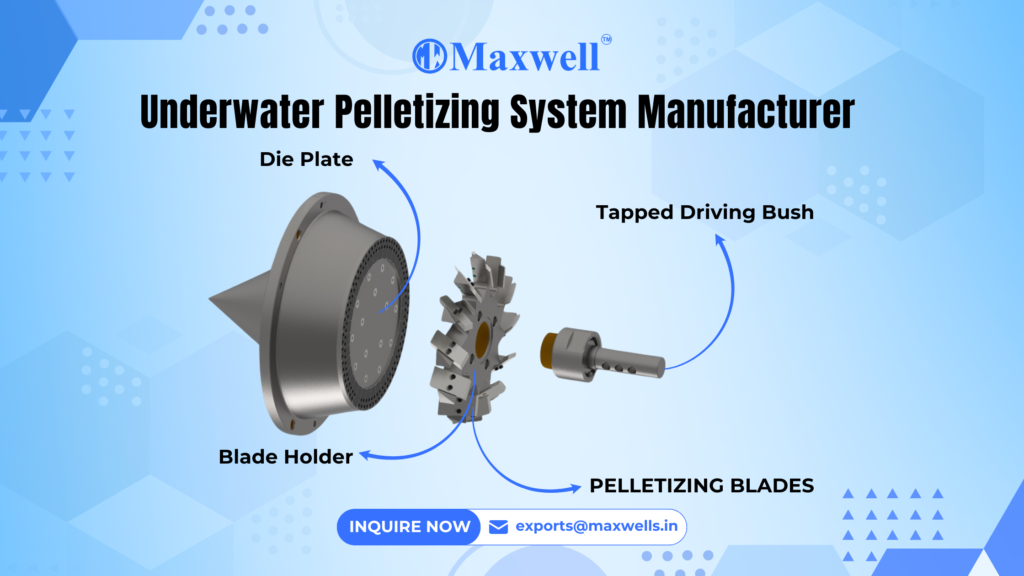

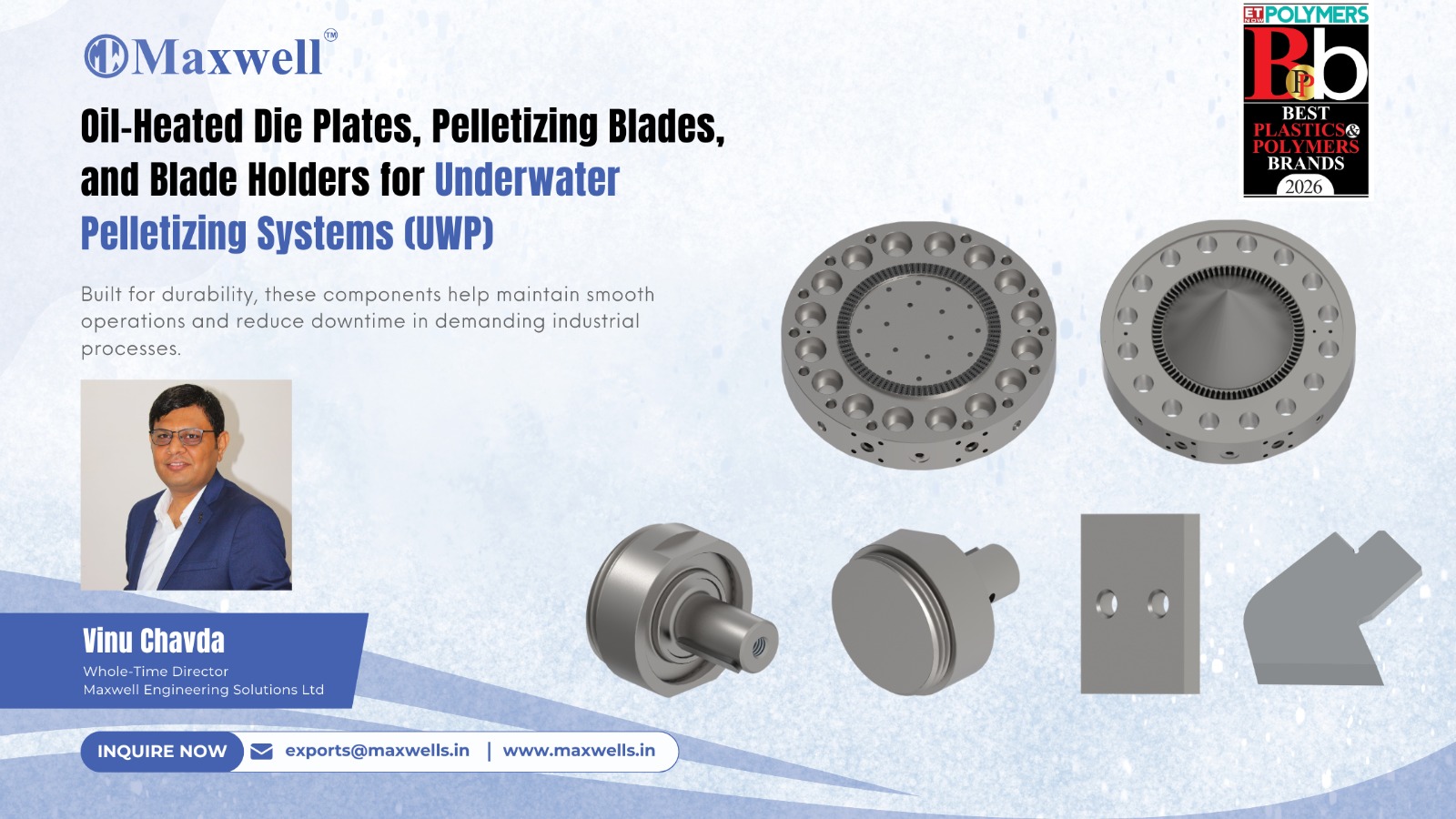
Oil-heated die plate UWP systems are essential for achieving consistent pellet quality and high-performance underwater pelletizing operations. In any UWP setup, the die plate, pelletizing blades, blade holders, and tapped driving bushes must work in perfect synchronization to avoid defects like angel hair, freeze-off, and uneven pellets.
Maxwell Engineering Solutions Limited manufactures and supplies complete component solutions, including oil-heated die plate UWP systems, for global polymer and compounding industries.
What Is an Oil-Heated Die Plate, and Why Does It Matter?
The die plate is the functional heart of any underwater pelletizing system. Molten polymer is forced through its precision-drilled perforated holes, and rotating blades on a holder cut the emerging strands into pellets in a water-filled cutting chamber. For this to work correctly every single cycle, the die plate face must stay at a precise, uniform temperature, with no cold zones and no hot spots.
There are two main methods of heating a die plate: electrical heating and oil heating. Both are widely used in industry, but oil-heated die plates carry specific advantages for certain applications and throughput levels.
In an oil/steam-heated die plate, thermic fluid oil/hot steam is circulated through internal channels machined into the die plate body. This circulating medium distributes heat evenly across the entire plate face, including the outer edges, which are most exposed to the cooling water in the cutting chamber. The result is exceptional temperature uniformity, which is critical for processing temperature-sensitive polymers such as PET, SAN, ABS, TPU, TPV, POE, PLA, PBAT, PA, and certain engineering resins, and also higher output lines of PP, PE, HDPE, etc.
Key advantages of oil-heated die plates over electrically heated alternatives include:
- More uniform heat distribution across the full die face, including peripheral zones
- Lower risk of localized overheating, which causes polymer degradation at the die face
- Suitable for higher-throughput systems where large die plate diameters make electrical heating less effective because of heat uniformity challenges
- Longer die plate service life due to reduced thermal stress cycling compared to cartridge heater-based designs
For polymerization plants, high-throughput compounding lines, and specialty polymer applications, the oil/steam-heated die plate UWP is frequently the preferred solution, and it is an area where Maxwell has developed specific manufacturing expertise.
New and Refurbished Die Plates: Both Are Maxwell's Strength
One of Maxwell’s key differentiators in the market is the ability to supply both new die plates and fully refurbished units. This matters more than many operators realize.
A new oil-heated die plate is the right choice when your production requirements, polymer type, or throughput targets have changed or when a worn unit has been run beyond the point where refurbishment is economical.
Refurbished/reconditioned die plates, on the other hand, represent significant cost savings when the body of the plate is structurally sound, but the working face has worn. Maxwell’s refurbishment process restores die face flatness, refinishes the orifice holes for clean polymer flow, replaces worn insulation elements, and pressure-tests the internal oil channels before the plate leaves the facility. A correctly refurbished die plate performs to the same standard as a new unit for a fraction of the replacement cost.
For plant managers running continuous UWP operations, this dual supply capability, new or refurbished, depending on condition and budget, provides real commercial flexibility.
Pelletizing Blades for UWP: Precision Is Non-Negotiable
The rotating blades in an underwater pelletizing system cut the molten polymer strands at the die face thousands of times per minute, in direct contact with both hot polymer and cold water. The demands for blade material and geometry are severe.
Maxwell manufactures UWP pelletizing blades in both solid and bimetallic configurations. Bi-metallic blades with a high-speed steel or titanium carbide-tipped cutting edge bonded to a stainless-steel body are the industry standard for most polymer types, offering a combination of wear resistance at the cutting edge and toughness in the blade body.
Blade geometry is matched to the die plate specification. Whole circle diameters, blade radius, and contact angle must all align for clean cuts and minimal fine generation. An incorrectly specified blade produces angle hair, tail forming, and accelerated die face wear, directly raising your operating costs.
Maxwell supplies blades compatible with all major UWP platforms, including systems from Nordson BKG, Gala/Maag, Coperion, JSW, Kobe, David-Standard, Farrel-Pomini, and others. Custom blade profiles are available based on a sample or drawing.
Blade Holders: The Component Most Operators Underestimate
Blade holders position the cutting blades against the die plate face and apply the correct contact pressure during operation. They sound simple. They are not.
A worn or dimensionally inaccurate blade holder changes the blade angle at the die face. Even a small angular deviation causes uneven contact across the die surface; some blades cut too deep while others barely graze the face. The result is inconsistent pellet size, increased die face wear, and shortened blade life.
Maxwell machines blade holders to tight dimensional tolerances from appropriate alloy steels. The holder geometry is matched to the cutter hub design of the specific pelletizing system, ensuring that blade pressure is distributed correctly across the full die face.
Why Source All Four Components from Maxwell?
There is a practical reason to source your UWP die plates, pelletizing blades, and blade holders from a single, specialist aftermarket manufacturer: fit matters.
These components work as a system. A die plate that is machined to slightly different tolerances than expected changes the blade contact geometry. A blade holder that is a fraction of a millimeter off in its mounting geometry puts an uneven load on the die face. When one specialist manufacturer designs and produces all four components with matching specifications, the risk of compatibility issues disappears.
Maxwell Engineering Solutions Limited, headquartered in Vadodara, Gujarat, India, has over two decades of experience in this pelletizing domain. The company serves clients in 50+ countries, from large polyolefin producers and high-performance resin to specialist recycling operations running PET, rPET, HDPE, and PP lines.
Beyond supply, Maxwell offers:
- Refurbishing and reconditioning of worn die plates
- Simulation-driven re-engineering for components that repeatedly underperform in specific applications
- Spare parts management and contracting to eliminate unplanned downtime from component shortages
- Grinding services for precision surface restoration of die plates
Conclusion
An underwater pelletizing line is only as reliable as the four components at its cutting core: the die plate, blades, blade holders, and tapped driving bushes. Operations utilizing oil-heated die plate UWP systems face even greater challenges: the thermal precision that enhances oil heating also necessitates precision manufacturing to ensure compatibility.
Maxwell Engineering Solutions delivers new and refurbished oil-heated die plates, matched UWP blades, blade holders, and tapped driving bushes engineered for performance, backed by two decades of specialist aftermarket expertise, and available to customers worldwide.
Enquire now: exports@maxwells.in or visit our Contact Us page.