
If you run a Polyolefins recycling (PCR) or pelletizing line, you already know the laser filter is one of the most valuable and most worked pieces of equipment in your plant. It runs hot, it runs continuously, and it takes the full force of contaminated melt every single hour of your production shift. What keeps it performing at that level isn’t magic. It’s the quality of the spare parts inside it.
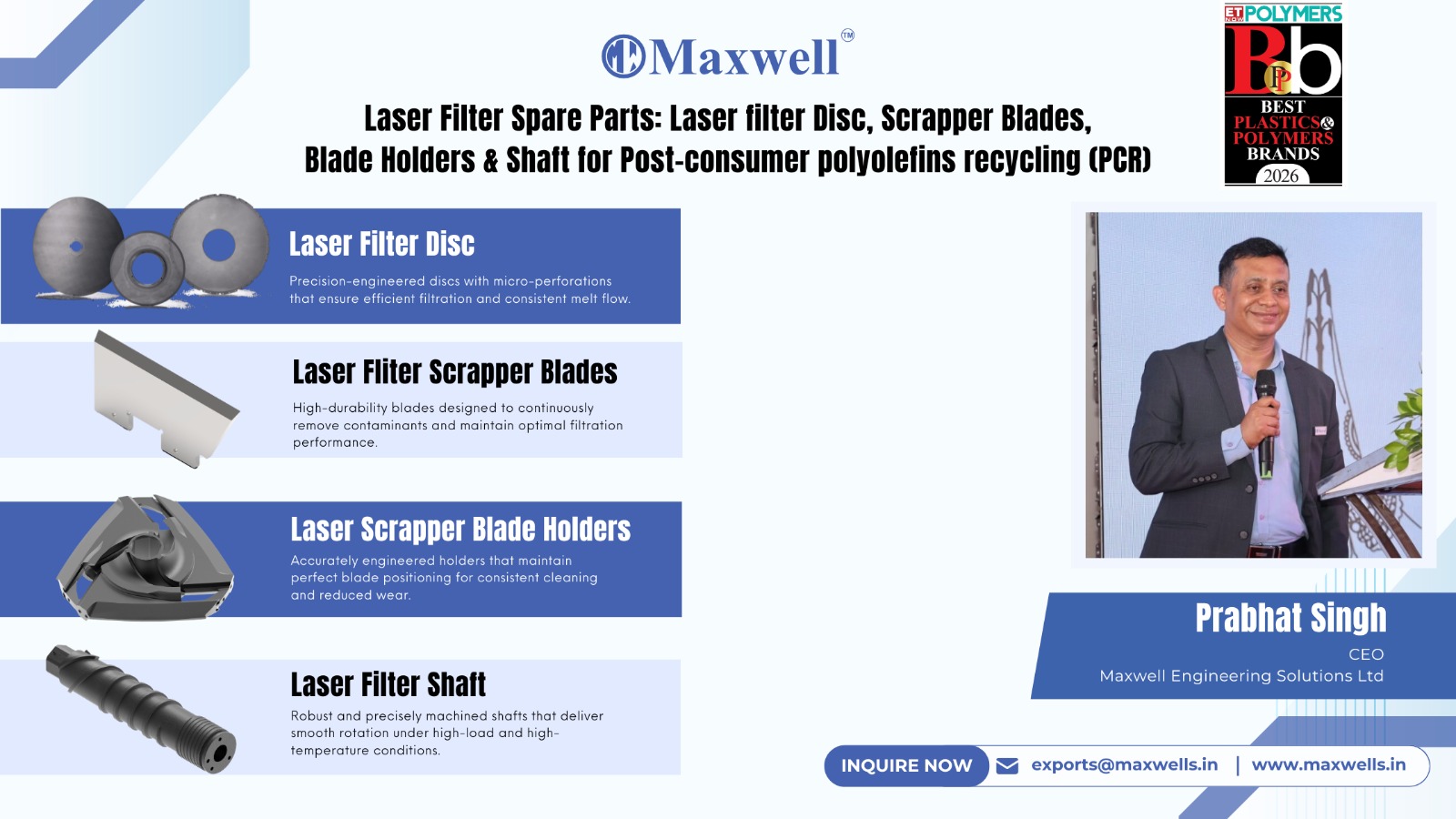
Maxwell Engineering Solutions Limited recently delivered a complete set of laser filter spare parts to a customer, covering laser discs, scraper blades, scraper blade holders, and shafts. In this post, we break down what each of these components does, why their quality matters more than most recyclers realize, and what to look for when sourcing laser filter spare parts for your line.
What Is a Laser Filter, and Why Do Its Spare Parts Matter?
A laser filter (also called a melt filter or laser disc filter) is a self-cleaning filtration system used primarily in post-consumer polyolefin recycling processes. Instead of a traditional wire mesh screen that needs manual replacement and frequent changeover, a laser filter uses precision laser-drilled discs to continuously separate contaminants from the polymer melt without stopping the line.
The system works because of four core components working together: the laser disc, the scraper blade, the blade holder, and the drive shaft. If any one of these components wears beyond its tolerance, the entire filter’s efficiency drops. You get inconsistent melt pressure, higher contamination in output pellets, and eventually, unplanned downtime.
This is why sourcing quality laser filter spare parts, not just any available replacements, is a production-critical decision.
The Four Components Maxwell Supplied and What Each One Does
1. Laser Filter Discs
The laser disc is the heart of the filtration system. It is a hardened steel plate with thousands of micro perforations, typically 90 to 500 microns in diameter, drilled by precision laser equipment. Contaminated recyclates melt through these holes; particles larger than the pore size are captured on the disc surface and scraped away.
The quality of a laser disc is determined by the following factors:
- Hole quality: Burr-free, consistent bore geometry across all perforations. Any burr or irregularity at the hole edge causes premature clogging and a melt hangup.
- Surface hardness: Discs are typically treated to 800 HV to resist the continuous abrasion of contaminated melt. Softer discs wear faster and lose filtration precision.
- Flatness: A disc that warps under thermal cycling will create uneven contact with the scraper, reducing cleaning efficiency and accelerating wear on both parts.
Maxwell delivers laser filter discs with precise measurements and surface qualities that are designed to handle the tough conditions of recycling materials that have a lot of contamination.
2. Scraper Blades
The scraper blade is the component that physically removes contaminants from the laser disc surface. As the disc rotates, the scraper lifts pressed-on particles and direct them toward the discharge outlet, ideally removing contaminants while retaining as much good melt as possible.
A worn or incorrectly specified scraper blade causes two problems at once:
- Incomplete cleaning: Contaminants build up on the disc surface, blinding the holes and reducing throughput. Melt pressure rises, the extruder struggles, and output quality falls.
- Disc damage: A blade that is too hard, too soft, or improperly angled can score the disc surface, turning a repairable wear situation into a full disc replacement.
Scraper blades for laser filters are typically manufactured from high-alloy tool steels or sometimes carbide-tipped materials, ground to a precise edge angle that balances cleaning effectiveness against disc protection. The correct material grade depends on the polymer type, contamination level, and operating temperature of the specific filter unit.
3. Scraper Blade Holders
The blade holder is the mechanical interface between the scraper blade and the drive shaft. It positions the blade at the correct angle and applies the right amount of contact pressure against the disc face.
This component is often overlooked, but it is critical. A worn or distorted blade holder changes the blade’s geometry at the disc surface. Even a slight angular error translates directly into poor scraping performance, uneven disc wear, and blade chatter that damages both components.
Blade holders must maintain dimensional stability under the combined stress of thermal cycling, continuous rotation, and the mechanical load of scraping contaminated melt. Material selection and precise machining are non-negotiable for long service life.
- Drive Shafts
The shaft transmits the rotation that drives the scraper assembly. In a laser filter, the shaft operates under constant torsional load, often in a high-temperature environment with exposure to polymer melt. Shaft wear or runout, even in fractions of a millimeter, translates into vibration, uneven blade contact, and accelerated wear across every connected component.
When Maxwell provides a shaft for a laser filter assembly, they ensure that the size and material are held to the same high standards as any other precision-made part. A correctly machined, correctly specified shaft is the foundation that protects the investment in every other spare part in the assembly.
Why Source Laser Filter Spare Parts from Maxwell?
The laser filter market has a well-known challenge: OEM spare parts from major system manufacturers (compatible with EREMA, FIMIC, and others) are expensive, often slow to deliver, and sometimes unavailable in the quantities smaller recycling operations need.
Maxwell Engineering Solutions Limited was established specifically to address this gap. As a specialist aftermarket solution provider for precision components for pelletizing, recycling, and extrusion systems, Maxwell supplies laser filter spare parts, including discs, scraper blades, holder pins, rolls, and shafts that are engineered to perform to the same standard as OEM components and have the advantages of
- Faster lead times from our hub in Vadodara, Gujarat, India
- Global delivery to clients across 50+ countries
- Component-level supply: you order what you need, not a minimum full-assembly kit
- Refurbishment support: sometimes, worn shafts and holders can often be reconditioned rather than replaced, reducing cost significantly
- Re-engineering capability: if a component repeatedly fails early in your application, Maxwell’s engineering team can analyse the failure mode and propose a redesigned solution
For recycling plant operators managing tight margins and demanding production targets, this combination of precision, availability, and aftermarket expertise makes a measurable difference.
Conclusion
Laser filters are built to run hard and run continuously. The components inside them, discs, scraper blades, holders, roll pin and shafts, are what make that possible. When those parts are precision-manufactured to the right specification, your filter performs consistently, your output quality stays high, and your downtime stays low.
Maxwell Engineering Solutions Limited delivers laser filter spare parts that meet these demands, engineered in Vadodara, trusted across 50+ countries, and available with the lead times and aftermarket support that OEM supply chains rarely offer.
Ready to discuss your laser filter spare parts requirement? Contact Maxwell at exports@maxwells.in