
How Water Ring Granulator for Polyolefins Recycling Works
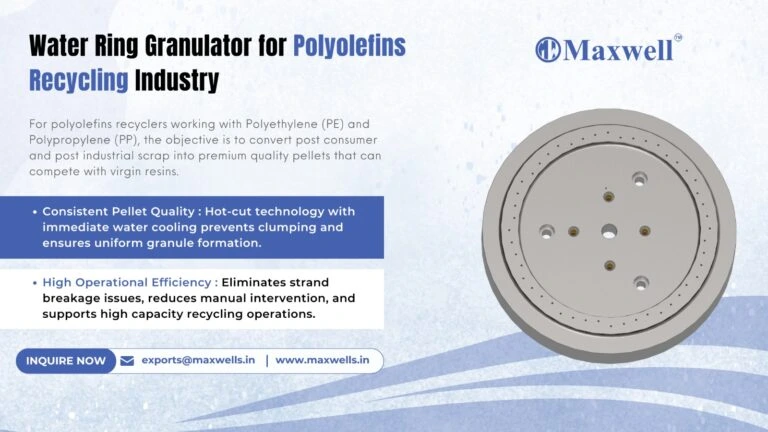
The Water Ring Granulator for Polyolefins is the most efficient way to convert polyethylene (PE) and polypropylene (PP) waste into uniform, high-quality pellets. Unlike traditional underwater pelletizers, this system uses precision pelletizing blades and hot-cut technology to deliver better consistency, lower energy usage, and higher productivity for modern recycling plants.
The journey from the scrap to the refined product is not easy. Achieving consistency in a volatile market requires precision, durability, and a deep understanding of material science. This is where the Water Ring Granulator stands out. It is the bridge between raw waste and high-value raw material.
At Maxwell, we understand that the recycling industry is built on both engineering excellence and the human effort to create a cleaner world. In this guide, we examine why water ring technology is the preferred choice for polyolefin processing and how it optimizes both environmental and operational outcomes.
Polyolefins work as the backbone of the global plastics industry. From the flexible films of LDPE and the structural integrity of HDPE to the thermal resistance of Polypropylene (PP), these materials are indispensable. Their varying Melt Flow Indices (MFI) and sensitivity to temperature mean that a minor fluctuation in processing can result in “clumping” or degraded material
Traditional strand pelletizing, while functional for certain applications, often struggles with the high-capacity demands of modern recycling. Strands break, requiring manual intervention, and atmospheric contamination, which leads to downtime, poor quality, and uneven pellet quality. To scale a recycling business effectively, an automated, reliable, and compact solution is required. The Water Ring Granulator was engineered specifically to solve these bottlenecks.
Technical Sophistication: How the Water Ring Granulator Operates
To understand the value of this technology, one must look at the centrifugal physics that drive it. Unlike underwater pelletizers, where the entire cutting assembly is submerged, the water ring system utilizes a “hot-cut” method in a dry environment, followed by immediate water quenching.
Extrusion and Cutting: The molten polymer is pushed through a precision-engineered die plate. As it emerges, high-speed rotating blades mounted directly against the die face slice the polymer into uniform granules.
Centrifugal Projection: The centrifugal force of the blades tosses these hot pellets outward toward the housing wall.
The Water Ring: A continuous, high-velocity stream of water flows along the inner circumference of the granulator housing. This “ring” of water catches the pellets, instantly cooling them and preventing them from sticking together.
Dewatering and Drying: The water-pellet slurry is then transported to a centrifugal dryer. Here, the water is separated and recirculated, while the dry, finished pellets are discharged for packaging.
Operational Advantages: Why the Industry is Shifting
The adoption of the Water Ring Granulator is driven by several key factors that directly impact a facility’s bottom line.
1. Human-Centric Design and Reduced Labor
In a traditional strand line, operators must constantly monitor the “strands” for breaks. If a strand snaps, the machine must be slowed or stopped for manual re-threading. This is labor-intensive and creates a stressful work environment. The water ring system is essentially self-starting and self-correcting. Once the parameters are set, it runs autonomously, allowing your workforce to focus on higher-value tasks like quality control and feedstock management.
2. Space Optimization
Floor space is one of the highest overhead costs in manufacturing. Strand lines require long cooling troughs that can span several meters. A Water Ring Granulator is remarkably compact, integrating the cutting and cooling phases into a single, localized unit. This allows recyclers to maximize their output-per-square-meter, effectively increasing the capacity of existing facilities without the need for building expansions.
3. Consistency and Marketability
In the circular economy, “quality” is the primary currency. If recycled pellets vary in size or have jagged edges, they will fail to feed properly into downstream injection molding or extrusion machines. Because the water ring system cuts the melt while it is at its most malleable state at the die face, it produces exceptionally uniform, spherical-to-lenticular pellets. This high bulk density ensures consistent processing for the end-user, allowing recycled content to be integrated into high-end applications seamlessly.
4. Versatility with Recycled Feedstock
Recycled polyolefins are rarely as pure as virgin resin. They may contain trace contaminants or have fluctuating melt strengths. The water ring system is incredibly forgiving. Its design allows it to handle the rheological shifts of post-consumer waste better than almost any other pelletizing method, ensuring that even lower-grade scrap is successfully upcycled.
The Maxwell Edge: Engineering with Empathy
At Maxwell, we do not view ourselves merely as equipment manufacturers. We are partners in your operational success. When we design a Water Ring Granulator, we prioritize the “Human Element”.
: the ease of maintenance, the safety of the operator, and the longevity of the components.
Our systems are built with:
Hardened/Tungsten carbide Die Plates: Optimized for thermal uniformity to prevent “freeze-off” (where the plastic hardens inside the die holes).
Suitable blades: Pelletizing blades with suitable metallurgy and mechanical design to produce uniform granules
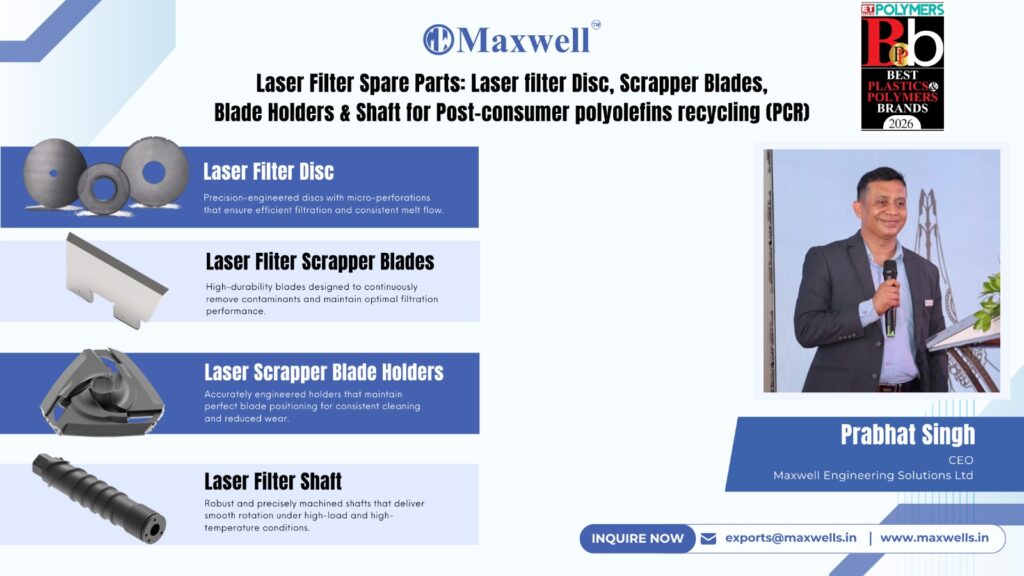
Laser filters: Laser filters, scraper blades, and shafts with an accurate design to handle post-consumer recycling
Cutter compactor blades: Cutter compactor/densifier blades with TC cutting surface to get more life and avoid downtime to replace blades frequently
We understand that in the recycling world, downtime is the enemy. Therefore, our machines are designed for quick cleaning and rapid blade changes, ensuring your line stays productive through multiple color or material shifts.
Economic and Environmental ROI
Investing in a Water Ring Granulator is both a financial and an ethical decision. As global brands commit to increasing the percentage of Post-Consumer Recycled (PCR) content in their products, the demand for high-quality pellets is skyrocketing.
By improving the efficiency of your recycling line, you are:
Reducing Energy Consumption: Modern water ring systems are more energy-efficient than traditional cooling tanks.
Eliminating Waste: Precise cutting reduces the amount of “fines” or dust produced during the pelletizing process.
Scaling Profitability: Higher quality pellets command higher market prices, accelerating the return on investment for your machinery.
Every ton of polyolefin successfully recycled represents a reduction in carbon emissions and a diversion of waste from our oceans and landfills. At Maxwell, we are proud to provide the technology that makes this environmental mission a profitable reality.
Conclusion:
Building a Sustainable Legacy
The recycling industry is no longer a niche sector; it is the cornerstone of the future of manufacturing. as we move toward a truly circular economy plastics system, the tools we use must be as sophisticated as the goals we aim to achieve.
The Water Ring Granulator represents the perfect synergy of physics and practical engineering. It empowers recycling facilities to produce a product that is indistinguishable in performance from virgin material, all while maintaining a safe, efficient, and compact workspace.
At Maxwell, we invite you to join us in this evolution. We are committed to providing the recycling industry with the robust, high-performance solutions needed to turn today’s waste into tomorrow’s resources.
Are you ready to optimize your polyolefin recycling line?
Explore our full range of granulating solutions at Maxwell and discover how our expertise can transform your production capabilities. Let’s engineer a sustainable future, together.